Structure-Targeted Peptide Computer-Aided Rational Design Technology Platform
STP-CADD
Fifth-Generation STP-CADD Structure-Targeted Peptide Rational Design Platform
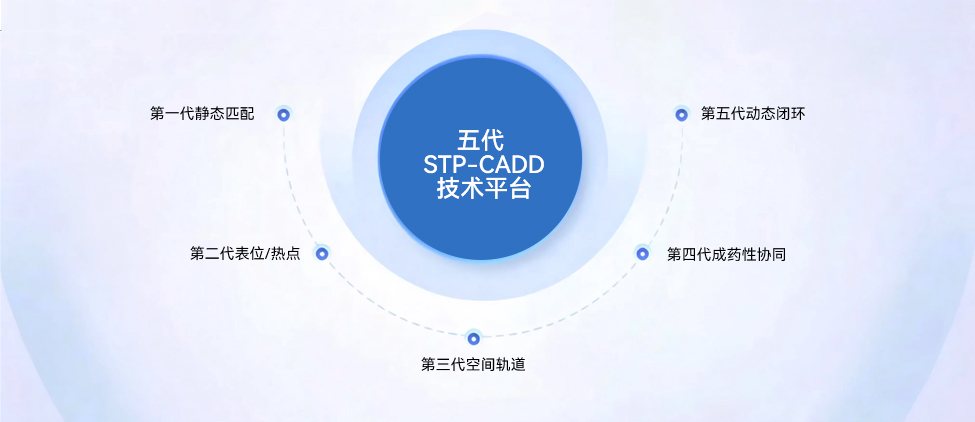
Anji Biotech has been deeply engaged in peptide design and development, accumulating systematic experience covering target structure elucidation, peptide structure-activity relationships, key amino acid identification, sequence optimization, cyclization and peptidomimetic modification, half-life regulation, and peptide conjugate development. Unlike platforms that rely solely on algorithms or large-scale random library construction, STP-CADD continuously distills the team's years of peptide design principles, failure cases, experimental data and druggability experience into computational models and standardized design workflows, enabling the platform not only to identify sequences that "theoretically can bind", but also to judge "which sequences are more likely to be synthesized, validated and further developed".
The STP-CADD platform has undergone continuous iteration from the first to the fifth generation. The first generation centered on static "Key-Lock" matching, designing complementary peptides based on the shape of target pockets; the second generation introduced binding epitope and hot-spot residue analysis, making key amino acids and their interactions more explicit; the third generation further considered peptide flexibility, conformational changes and spatial orbitals, upgrading from a single static conformation to multi-conformation design; the fourth generation simultaneously considered affinity design together with stability, hydrophilicity, charge, half-life, cyclization methods and linker compatibility, shifting the platform from "discovering targeted peptides" to "designing developable molecules"; and the fifth generation has formed an intelligent platform centered on full-space dynamic design, with deep closed-loop integration of computational design and wet-lab experiments, continuously correcting design models through experimental results to achieve iterative optimization of "design - validate - learn - redesign".
The five generations of the platform are not a simple algorithm update, but the continuous digitization and systematization of Anji Biotech's years of peptide experience. The team has extensive empirical judgment on the possible effects of different amino acid substitutions, sequence lengths, conformational constraints, conjugation sites and conjugation modules, allowing it to rule out ineffective directions early in design, reduce blind library construction and low-value synthesis, and concentrate limited experimental resources on a small number of high-information candidate molecules.
Based on this platform, Anji Biotech can start from the three-dimensional structure and accessible epitopes of targets to rapidly output candidate peptides with clear key residues, explainable mechanisms of action and clear optimization directions, and simultaneously design cyclization methods, linkers, chelators, hydrophilic modules and long-acting strategies according to different product needs, providing targeting modules ready for experimental validation and subsequent development for PRC, PDC, POC, PAC and other peptide-conjugated drugs.
The core moat of STP-CADD lies not merely in having computational tools, but in transforming years of accumulated peptide design experience into a replicable, iterable and verifiable design system.